Research
Department of Movement and Exercise Science
Summer School of the EU MSCA Doctoral Network "TReND" 2025 in Bern
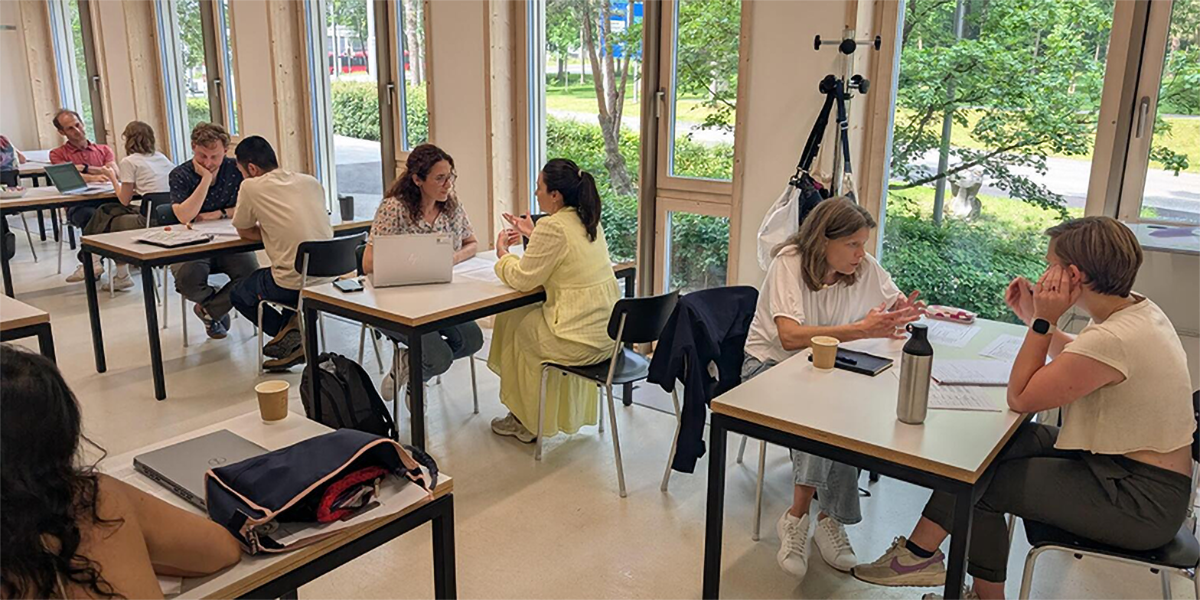
From the 10th to the 13th of June 2025, the Department of Movement and Exercise Science organised the first Summer School of the TReND project in Bern. TReND is a doctoral network (Translational Research Network in Motor Disorder Rehabilitation) funded by the EU as part of the Marie Skłodowska-Curie Actions, to which Ernst-Joachim Hossner, Stephan Zahno and Ralf Kredel are associated through SERI funding and in which Constanze Dammeyer is pursuing her doctorate. In addition to keynote lectures, training sessions and an accompanying social programme – entirely organized by Damian Beck –, there were also innovative supervision formats such as a speed dating round to deepen networking among doctoral students researching in Belgium, Germany, France, Israel, the Netherlands, Sweden, Switzerland and the United Kingdom with the supervisors of the network (see photo).
The contribution of the Bern sub-project to the TReND network primarily addresses the problem of dealing with uncertainty in elderly people and the development of new approaches to maintaining or even improving gait stability. This also creates synergies with current work by the movement-science research group on sensorimotor control under risk (postdoc project by Stephan Zahno), on Bayesian integration for the purpose of reducing uncertainty (doctoral project by Damian Beck) and on sensory integration in interpersonal coordination (doctoral project by Mathilde Truffer). Relevant publications on this topic include:
Beck, D., Hossner, E.-J., & Zahno, S. (2023). Mechanisms for handling uncertainty in sensorimotor control in sports: A scoping review. International Review of Sport and Exercise Psychology. Advance online publication. https://doi.org/10.1080/1750984X.2023.2280899
*Beck, D., *Zahno, S., Kredel, R., & Hossner, E.-J. (2025). From simple lab tasks to the virtual court. Bayesian integration in tennis. Journal of Neurophysiology, 134, 303–313. https://doi.org/10.1152/jn.00434.2024
*Zahno, S., *Beck, D., Hossner, E.-J., & Kording, K. (2025). Humans can learn bimodal priors in complex sensorimotor behaviour. bioRxiv. https://doi.org/10.1101/2025.02.12.637788
Beck, D., Hossner, E.-J., & Zahno, S. (2025). Exploiting prior knowledge in continuous decision-making under uncertainty: The case of tennis experts. Research Square. https://doi.org/10.21203/rs.3.rs-7154501/v1
Zahno, S., Beck, D., Kredel, R., Klostermann, A., & Hossner, E.-J. (2025). Risk optimization during ongoing movement: Insights from movement and gaze behavior in throwing. Journal of Neurophysiology, 134, 94–106. https://doi.org/10.1152/jn.00606.2024
Other current research projects by department members relate to the connection between night-time sleep and athletic performance (Daniel Erlacher), motor control and learning in dance (Andrea Schärli), biomechanical-technological applied research on coordination training (Ralf Kredel, Heinz Hegi), the use of contextual knowledge in handball decision-making (Lukas Magnaguagno), the promotion of game-intelligent behaviour in football (Stephan Zahno), precision performance in rifle shooting (Dino Tartaruga), and motor learning in lucid dreaming (Emma Peters, Xinlin Wang).
Ernst-Joachim Hossner